Trending

Buying art can feel like a test you didn't revise for. You know what you like the moment you see it, but standing in a gallery or scrolling through a print shop raises a dozen small anxieties: what size, whether it needs framing, how high to hang it, and whether any of it matters when you're working with a few hundred pounds rather than a few thousand. It matters, but less than you'd think. Most of the decisions come down to a few measurements and one firm rule — buy what you actually like.
Take a photo of the wall you have in mind, with the furniture in shot, and look at it on your phone while you browse. It sounds obvious, but the print that looks enormous on a laptop screen can vanish above a sofa, and the small, delicate one you skipped past may be exactly right for the narrow gap beside a door.
Two rough rules of thumb are worth remembering. Art hung above a sofa or a bed should span roughly two-thirds of the width of the furniture beneath it — narrower and it looks lost, wider and it dominates the room. On a wall of its own, try to leave at least 15cm of clear space between the frame and any corner or doorway so the piece has room to breathe.
Then make a template. Cut or trace the outer dimensions of the frame onto newspaper or lining paper, tape it to the wall and live with it for a day. You'll spot a mistake in minutes rather than after you've hammered in a hook.
Frames and prints mostly follow paper sizes, which makes life much easier once you know what you're looking at.
The medium matters as much as the size. Giclée prints are made with pigment inks on fine art paper and hold their colour well. Screen prints are pushed through a mesh by hand, so slight variations and a visible ink texture are part of the appeal. Risograph prints use soy-based inks and a limited palette, giving them a flat, slightly grainy look. None of these is inherently better than the others; they simply behave differently behind glass.
Framing can easily cost more than the artwork itself, so decide your approach before you buy. There are three sensible routes:
Wherever it ends up, keep art out of direct sunlight and away from radiators and fires. Heat and light are the two things that quietly ruin paper.
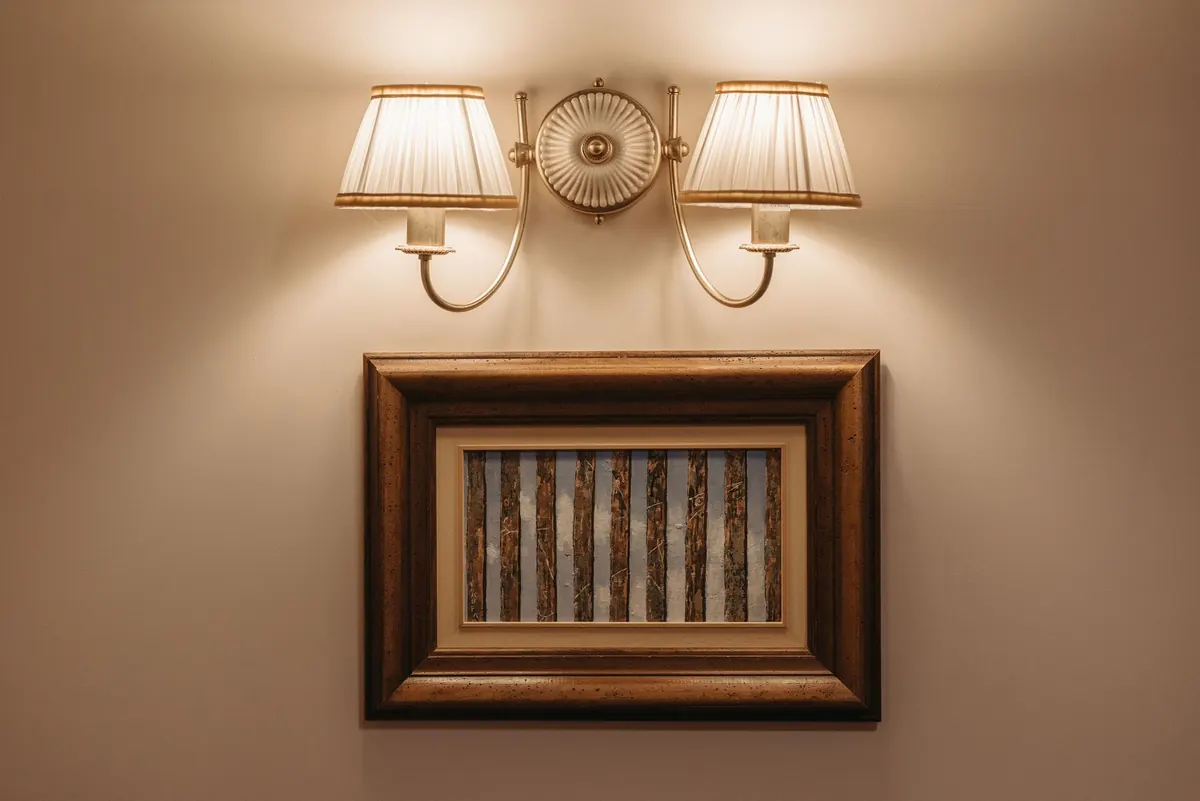
Galleries and professional picture hangers generally work to a simple convention: the centre of the artwork sits about 145cm from the floor, roughly eye level for most adults. If you're hanging above furniture rather than on an empty wall, leave 15–25cm between the bottom of the frame and the top of the sofa, sideboard or bedhead.
For a group of pictures, treat the whole arrangement as one shape and centre that shape on the 145cm line. Keep the gaps between frames even — somewhere between 5cm and 8cm reads well — and align at least one edge. A grid of identically sized frames is the most forgiving layout for a beginner. A looser arrangement works too, but it's harder to get right.
Use two hooks for anything wider than a hand's span, and check the weight rating on the packet. Picture hooks are cheap; replastering is not.
The trick is to give a wall one thing in common and let the rest vary. That common thread might be colour — every piece carrying a trace of the same blue — or subject, or mood, or simply frame colour. Matching frames in different sizes will happily hold together a landscape, a portrait and an abstract.
Don't buy the whole wall in one afternoon. Collections look like collections because they were built over time, which also gives your taste a chance to catch up with your spending. Buy one piece you love, live with it for a month, then find its neighbour.
You don't need a gallery budget to have good art on your walls.
Old postcards, sheet music, maps and magazine covers can look excellent in a decent frame with a wide mount. If it means something to you, it belongs on the wall.
Pick the wall you look at most, not the one visitors see first. Measure it, settle on a rough size, and set a budget that includes framing. Buy one piece you'd happily own even if nobody ever commented on it. Frame it sensibly, hang it at 145cm, and stop there for a while. The second purchase is always easier than the first, and by then you'll know exactly what your eye keeps returning to.
Photo: Pavel Danilyuk / Pexels