Trending

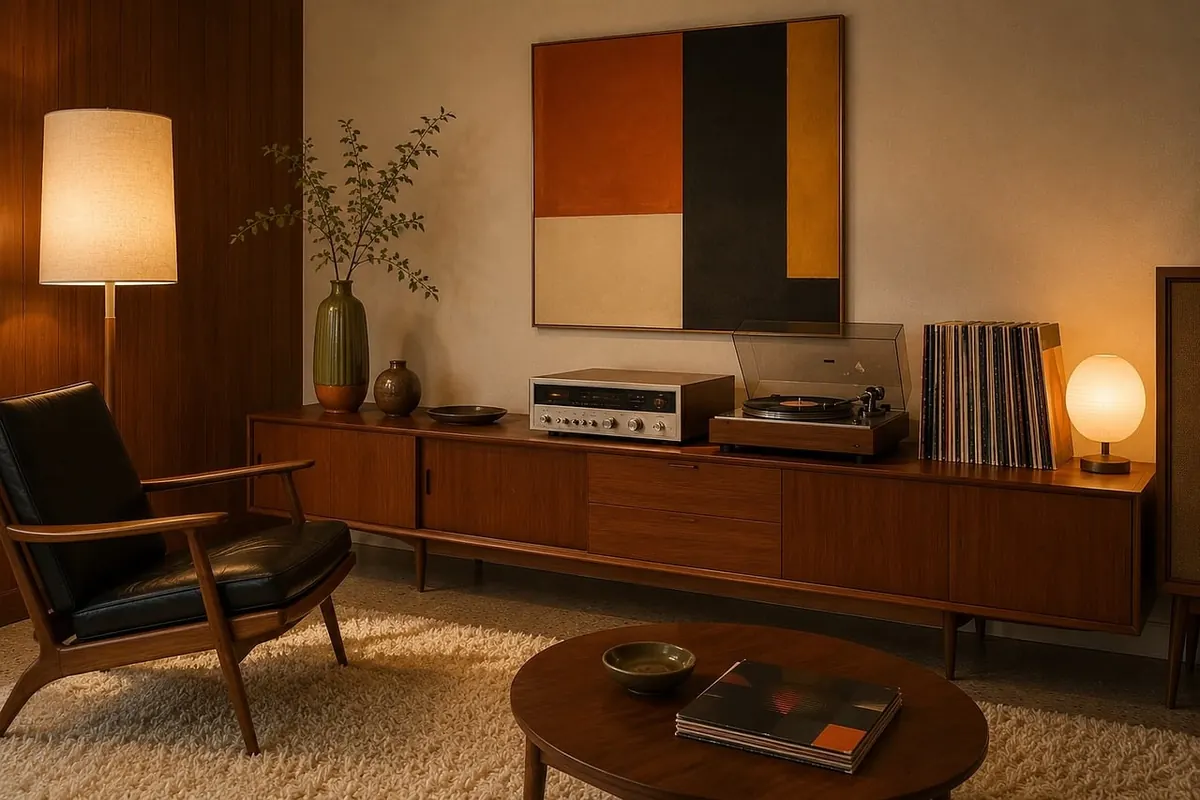
Ask someone to picture mid-century modern and they will usually describe the same thing: a teak sideboard with tapered legs, a lamp on a brass stem, a chair that looks as though it might take off. The label gets attached to almost anything with a wooden leg and a bit of shine, which is why plenty of people are quietly unsure what it actually means. The style borrows from Scandinavian craft, American industrial design and post-war optimism, and it has been diluted by decades of reinterpretation. What follows is a plain-English guide to the real thing — and to using it in a home that is not frozen in 1958.
Mid-century modern describes design made roughly between the mid-1940s and the late 1960s, with a little spill either side. The phrase itself arrived much later, applied retrospectively by collectors and writers who needed a name for a period that never really named itself.
What tied those years together was circumstance. After the war, manufacturers had new materials to work with — moulded plywood, fibreglass, tubular steel, injection-moulded plastic — and a new audience: families moving into smaller, lighter homes that needed furniture to match. Designers responded with pieces that were strong but slim, affordable to produce but generous in form. Charles and Ray Eames in America, Arne Jacobsen and Hans Wegner in Denmark, and Robin Day in Britain all worked inside that brief. Ercol and G Plan brought their own versions of it into British living rooms, which is why so much of it still turns up in house clearances and charity shops.
If you remember nothing else, remember this: mid-century furniture looks lifted. Almost every piece sits on tapered legs or a slim base, so you can see floor underneath. That visible gap is what stops a room feeling heavy, and it is the quickest way to tell a genuine period piece from a later imitation.
Beyond the legs, the shapes are softer than you might expect. Corners are rounded rather than sharp. Chair backs are low and often curved. Sideboards are long and shallow rather than deep and boxy. Even the angular pieces — a grid of drawers, a geometric print — usually sit inside a silhouette with a curve somewhere in it.
Wood is the backbone: teak, walnut, beech and, at the pricier end, rosewood, which is now subject to strict trade restrictions and best bought vintage and carefully. Grain is meant to be seen and enjoyed, so look for thin, warm-toned veneers over solid frames rather than thick slabs. Plywood with its edges left visible is authentic too — the moulded chairs of the period made a feature of it rather than hiding it.
Then come the industrial materials. Moulded plastic and fibreglass shells, chromed or powder-coated steel tube, brass, glass, and a good deal of cane and rattan woven into chair backs. Textiles were honest and hard-wearing: wool, tweed, linen, leather, and later the scratchy geometric weaves that still divide opinion.
Whatever you buy, resist the urge to sand it back to bare wood. Teak and walnut were finished to look warm and slightly matte. A wipe with mild soapy water and a little oil does more good than a full restoration, and it protects the value of the piece.
Mid-century colour is warmer and more saturated than the pale grey interiors that have dominated for the past decade. Think mustard and ochre, teal, olive, rust, burnt orange, deep navy, with black and white used as punctuation and walnut brown doing the heavy lifting underneath.
The mistake is to use all of them at once. A room with an orange sofa, a teal wall, a mustard cushion and a patterned rug stops reading as a style and starts reading as a jumble sale. Instead, choose a neutral base — off-white, oatmeal, warm grey or a soft sage — then pick exactly one accent from the list above and let it appear three times in the room. A lampshade, a cushion, a small framed print. That repetition is what makes a palette look deliberate rather than accidental.
Pick the one piece you will actually use every day — a chair you read in, a sideboard that hides the clutter, a lamp that makes the evening feel calmer. Measure the space properly before you fall in love with anything online, and check joints, wobbles and drawer runners in person where you can. A small repair is fine; a piece that needs structural work usually is not.
Then live with it for a month before buying anything else. Mid-century modern is not a scheme you install in a weekend. It is a handful of well-made objects with good proportions, chosen slowly, that happen to sit very comfortably in a modern home.
Photo: AestheticPix / Pixabay